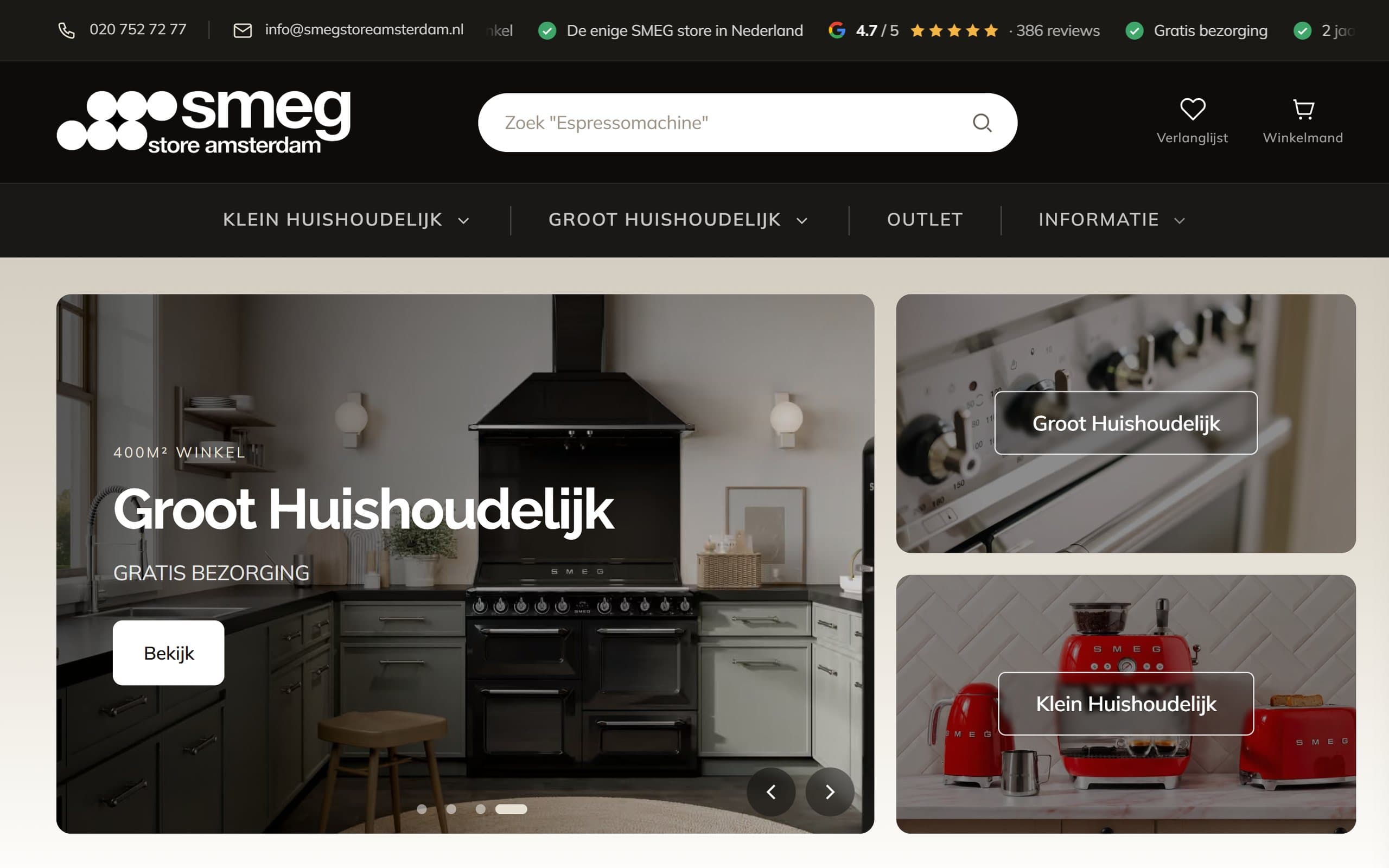
Smeg Store Amsterdam wanted a store that looks as good as the showroom, works fast on a phone and can be maintained by the team itself, without Monta, Stockflow or payments being down for a single day. We rebuilt the store and took it live in one night, with every order and integration intact.
Scores from Google PageSpeed Insights for smegstoreamsterdam.nl, measured on 6 October 2026. On mobile Google tests with a simulated mid-range phone on a slower network.
Smeg Store Amsterdam is the Amsterdam store of the Italian design brand, with a 400 m² showroom and a separate outlet department. Exceptis already handled the hosting and Google Ads for the previous store. That store ran on a heavy WordPress theme with many separate plugins, and the categories had grown into a tree with many near empty subcategories. The brief was a new store that fits the brand, is fast on mobile and can be maintained by the store itself.
The new store is built headless. What visitors see is a Next.js frontend. WooCommerce remains the back end for products, stock and orders and supplies its data through the API. Pages are built in advance and served straight away, and a change in WordPress is online within seconds. Google PageSpeed Insights measures 97 on mobile and 100 on desktop for performance.
The category structure was set up again: the category is the product type, such as retro fridges, built in fridges or range cookers, and colour, width, energy class and model are filters. Customers always land on a real category page instead of a search result. The search field suggests products while you type, also searches product descriptions, understands a size such as "range cooker 90 cm" and handles typos. On the product page customers choose the colour of a model and see the energy label and whether it is an outlet model.
Large appliances come with delivery choices. Each product shows its delivery options with their price, such as standard delivery, full service delivery and taking away the old appliance. The store manages these options itself in WordPress. In the custom checkout customers choose between delivery on a preferred day or pickup in the store, the address fills in from the postcode and house number, and payment runs through Mollie, including iDEAL.
Monta handles shipping: it fetches new orders, updates stock and adds the PostNL tracking code to the order. Stockflow reads orders and products for stock management, see our Stockflow integration. The frontend generates the product feed for Google Merchant Center itself, so the Shopping campaigns always show current prices and products. Titles and descriptions for Google come from Yoast SEO, which the store keeps using in WordPress.
Almost everything a visitor reads can be edited in WordPress: store information and opening hours, the benefits at the top of the page, the homepage, the menu and footer, product labels, promotional banners and even the texts on buttons and in the checkout. After saving, the change is live within seconds without rebuilding anything.
The new store went live in the night of 6 October 2026. Orders and customer accounts moved over one to one, with the same product numbers, so Monta, Stockflow, Mollie and Google Merchant Center kept working without interruption. More than 1,250 old addresses redirect to the right new page, the old domain smegoutletamsterdam.nl redirects to the new store, and in Google Ads the campaigns and sitelinks now point to the new pages. The ongoing Google Ads management stays with Exceptis.
Tell us what you have in mind, we will get back to you within one working day with concrete next steps.